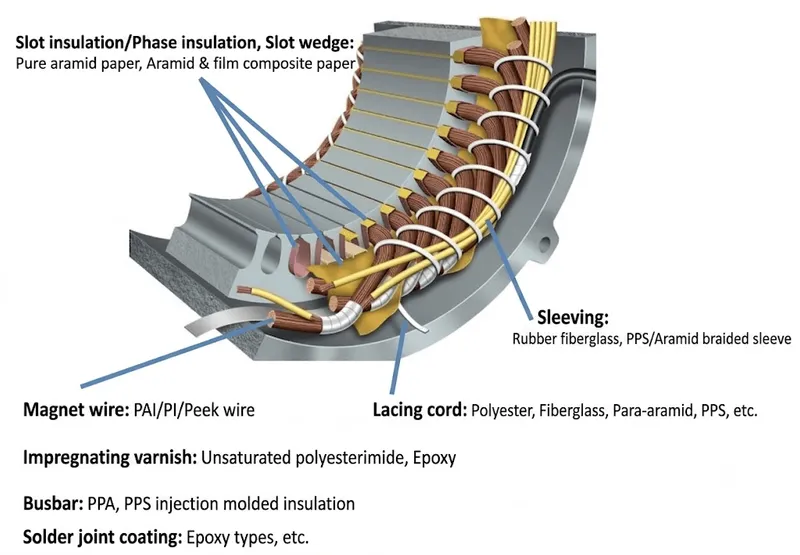
Q: What does motor insulation include?
A: Motor insulation includes the insulation between strands, turns, rows, and layers of the coil, as well as ground insulation, various insulating components used for support or fixation at the ends, and the insulation of connecting wires and lead wires.
Q: What is the main insulation of a coil?
A: The main insulation of a coil refers to the insulation between the coil and the machine body (core) as well as other windings. It is also customarily called ground insulation.
Q: What is turn-to-turn insulation?
A: Turn-to-turn insulation refers to the insulation between adjacent turns of the same coil.
Q: How are laminated products made?
A: Laminated products are layered insulating materials made by dipping or coating fiber-based substrates with different adhesives, which are then subjected to hot pressing or rolling. They mainly include laminated boards, tubes (cylinders), rods, and special profiles.
Q: What are the commonly used varnished tubes?
A: Commonly used varnished tubes include 2751 silicone rubber glass varnished tubes (Class H insulation) and 2750 silicone glass varnished tubes (Class H insulation).
Q: What materials are insulating varnished tubes made of? What is their main function?
A: Insulating varnished tubes are flexible tubular materials with certain electromechanical properties, woven from natural fibers, synthetic fibers, or alkali-free glass fibers, then impregnated with insulating varnish or resin and baked dry. They are mainly used for the insulation of lead wires and inter-pole connecting wires of low-voltage coils or windings.
Q: What types of varnished glass cloth are commonly used for coil insulation?
A: Four types of varnished glass cloth are commonly used: 2430 asphalt alkyd glass cloth, 2432 alkyd varnished glass cloth, 241 polyester varnished glass cloth, and 2450 silicone varnished glass cloth.
Q: What are the advantages and disadvantages of glass fibers? What methods are commonly used to improve their disadvantages?
A:
- Advantages: Strong tensile strength, high heat resistance, and low moisture absorption.
- Disadvantages: Poor flexibility and lack of folding endurance.
They are often interwoven with synthetic fibers or subjected to chemical treatments to improve their flexibility and the adhesion of the varnish film.
Q: What are impregnated fiber products made of?
A: They are fiber products made by using insulating fiber materials as substrates and impregnating them with insulating varnish, such as varnished cloth, varnished tubes, and binding tapes.
Q: What are the two types of curing agents for epoxy resins based on curing temperature?
A: Room temperature curing agents and heat curing agents.
Q: What are the two commonly used epoxy resins for coil insulation?
A: The commonly used epoxy resins are Bisphenol A type and Phenolic type epoxy resins.
Q: What are the basic principles for selecting insulating covering varnishes?
A:
- Fixed color; the varnish film should be smooth, flat, bright, and glossy.
- High dispersion and strong covering power.
- Long storage life, good stability, and no gelation.
- The varnish film must have sufficient hardness, wear resistance, and good mechanical properties.
- Good arc resistance and dielectric properties.
- Good resistance to moisture, oil, and chemical corrosion. For motors used in tropical climates, it should also have anti-fungal and anti-salt-spray properties.
- For special anti-corona covering varnishes used in high-voltage motors, they must also have good resistance stability, uniformity, and a specific resistance value.
Q: What are the basic principles for selecting insulating impregnating varnishes?
A:
- Low viscosity and high solid content to facilitate penetration and filling of the impregnated object, allowing for a large amount of varnish retention.
- Fast curing in thick layers, good drying properties, strong adhesive force, and an elastic film that can withstand centrifugal forces during motor operation.
- Good electrical properties, heat resistance, moisture resistance, oil resistance, and chemical stability.
- Harmless to conductors and other insulating materials, with good compatibility.
- Affordable, domestically sourced materials, long storage life, and low toxicity.
Q: What are the two categories of insulating impregnating varnishes? What are their pros and cons?
A: They can be divided into two types:
- Solvent-based insulating impregnating varnishes.
- Solventless insulating impregnating varnishes.
The former has good permeability, a long storage life, low cost, and is convenient for use and production management. However, its disadvantages include a long baking and curing time, and solvent evaporation that causes waste and environmental pollution. The latter features fast curing, viscosity that varies greatly with temperature, low volatile emissions during curing, good dielectric insulation properties, and high varnish retention. However, it is expensive, has a shorter storage life, high viscosity, and complicated production management.
Q: How can insulating varnishes be classified by application?
A: According to their applications, insulating varnishes can be classified into impregnating varnishes, covering varnishes, silicon steel sheet varnishes, enameled wire varnishes, and adhesive varnishes.
Q: What are the two wire-insertion forms for wound-rotor windings? What types of motors are they suitable for?
A: Wound-rotor windings have two wire-insertion forms: scattered insertion and drop-in (pre-formed) insertion. The former is used for small motors, and the latter is used for medium and large motors.
Q: What are the types of non-salient pole rotor coils in synchronous machines?
A: Non-salient pole rotor coils in synchronous machines include continuous type, half-turn type, and single-layer concentric type.
Q: What are the two structural forms of salient pole rotor coils in synchronous motors?
A: The two structural forms are multi-layer multi-turn magnetic pole coils and single-layer multi-turn magnetic pole coils.
Q: What three materials typically make up the main insulation of a high-voltage motor form-wound stator coil? What does improving the main insulation primarily enhance?
A: The main insulation is typically composed of three materials: mica, reinforcing materials, and adhesives. Improving the main insulation primarily enhances the heat resistance of its adhesives and the overall performance of the motor.
Q: What insulations are mainly determined by the insulation structure of high-voltage motor form-wound stator coils?
A: It mainly determines the turn-to-turn insulation, slot insulation, end insulation, and lead wire insulation.
Q: What does a high-voltage motor refer to?
A: High-voltage motors generally refer to AC motors and generators with a voltage rating of 3kV and above.
Q: What determines the stator slot shape of medium and small motors? What slot shape is generally used in small low-voltage motors?
A: The stator slot shape of medium and small motors depends on the capacity, voltage, and winding type. Small low-voltage motors generally use semi-closed slots.
Q: What are the main factors determining the insulation structure of a low-voltage motor?
A: The main factors are the slot shape, wire insertion method, insulating materials, and insulation treatment process.
Q: What are the general thermal resistance classes for motor winding insulation?
A: Motor winding insulation can generally be classified into Class B, Class F, Class H, and Class C.
Q: Why are coils compared to the heart of a motor?
A: The motor insulation structure serves to isolate electricity, while some parts also provide mechanical support and fixation. During long-term operation, motor insulation is subjected to electrical, thermal, and mechanical forces, as well as various environmental conditions. The insulation gradually ages and eventually loses its intended performance, leading to insulation breakdown and the inability to continue operating safely. Therefore, the reliability and lifespan of motor operation are largely determined by the coil insulation, which is why coils are compared to the heart of the motor.
Q: What is row-to-row insulation?
A: Row-to-row insulation is the insulation between several rows of conductors connected in parallel.
Q: What is strand-to-strand insulation?
A: Strand-to-strand insulation refers to the insulation between the individual strands within the same turn, which is generally the insulation of the electromagnetic wire itself.
Q: What is the basic dielectric barrier in mica products?
A: It is mica.
Q: What are the properties of mica?
A: Mica possesses excellent dielectric insulation properties, high heat resistance, and chemical stability.
Q: What are the three types of widely used mica paper based on their preparation processes?
A:
- Calcined mica paper: produced from mica scraps using a thermochemical method.
- Uncalcined (raw) mica paper: produced from mica scraps using a high-pressure water crushing method.
- Large-flake mica paper: produced from pure mica materials using a high-pressure water impact method to yield larger flakes.
Q: What are the advantages of mica paper compared to mica splittings?
A: It has the following advantages:
- Improves the utilization rate of natural mica, increasing it from the original 7%-10% to over 80%.
- Mica paper has a uniform thickness, resulting in products with uniform thickness, thereby providing stable electrical properties and good thermal conductivity.
- Facilitates mechanized production of mica products, which improves production efficiency, lowers costs, and improves working conditions.
Q: What are mica products mainly composed of?
A: They are mainly composed of mica, adhesives, and reinforcing materials.
Q: There are many varieties of mica products. How can they be classified by application?
A: By application, they can be divided into four categories: mica tape, mica board, mica boxes (molded mica parts), and mica glass.
Q: What electrical films are currently commonly used for coil insulation? Briefly describe their common features and applications.
A: The commonly used electrical films are: 6062 polyester film, 6065 polyesterimide film, and polytetrafluoroethylene (PTFE) film.
- Common features: Thinness, flexibility, moisture resistance, and excellent electromechanical properties.
- Applications: Mainly used for coil wrapping insulation and slot insulation of low-voltage motors. PTFE film is often used as a release material during the hot pressing of coil insulation.
Q: Briefly describe the composition and purpose of composite products.
A: Composite products are insulating materials made by bonding fiber materials to one or both sides of an electrical film. The purpose is to enhance the mechanical properties of the film, improve its tear strength, and increase surface stiffness to improve its processing characteristics.
Q: What are the commonly used composite products?
A: Commonly used composite products include:
- 6520 polyester film electrical paper composite foil.
- 6530 polyester film varnished glass cloth composite foil.
- Polyester film/polyester fiber non-woven fabric composite foil (DMD).
- Polyester film/aromatic polyamide fiber paper composite foil (NMN).
- Polyester film/polysulfonamide non-woven fabric composite foil (SDMSD277).
- Polyimide film/aromatic polyamide fiber paper composite foil (NHN).
Q: What four aspects can the inspection items of insulating materials be divided into based on their performance?
A: Based on performance, they can be divided into four aspects: electrical, mechanical, physical/chemical, and thermal properties.
Q: What are the main contents included in testing the electrical properties of insulating materials?
A: They mainly include: breakdown strength, volume resistivity, surface resistivity, relative dielectric constant, dielectric loss tangent, and corona resistance.
Q: Write down the three basic calculation formulas for determining the component content of mica products, and indicate the meaning of the letters in each formula.
A:
- Volatile content X (%): X = (G - G1) / G × 100%
- Adhesive content Y (%): Y = (G1 - G2) / G1 × 100%
- Mica content Z (%): Z = [100% - (Y + K × K × F × D) / G1] × 100%
Where:
- G — Weight of sample before drying (g)
- G1 — Weight of sample after drying (g)
- G2 — Weight of sample after ignition (g)
- K — Standard weight of glass cloth (g/m²)
- F — Area of sample (m²)
- D — Number of reinforcing layers
Q: Briefly describe the two visual inspection methods for insulating varnishes.
A:
- Test tube method: Pour the varnish into a dry, clean, colorless glass test tube with a diameter of 15mm, and let it sit in the environment until the bubbles disappear; observe the color and transparency of the varnish against the light in daylight.
- Smear method: Take two pieces of varnish film samples used before the electrical performance measurement and observe the color, gloss, and presence of mechanical impurities or particles on the film.
Q: What are the basic technical requirements for form-wound stator coils in high-voltage motors?
A:
- Accurate number of turns and good turn-to-turn insulation.
- Good ground insulation.
- Coil dimensions and shape must meet the requirements.
- The main insulation should have good processing properties for wire insertion.
- Meet other special requirements, such as explosion-proof, moisture-proof, and anti-fungal properties.
Q: What are the common turn arrangements for form-wound high-voltage stator coils?
A: The arrangements include single-strand winding, double-row parallel winding, single-row parallel winding, bow-shaped transposition, N-shaped transposition, and brick-shaped arrangement.
Q: What are the types of turn-to-turn structural forms for form-wound high-voltage stator coils?
A: Usually, there are the following types:
- Using the winding wire insulation itself as turn-to-turn insulation.
- Inserting gold (polyimide) film strips between turns.
- Half-lapping a layer of mica tape at the nose portion or separating turns of the entire coil.
- Half-lapping 1 to 2 layers of mica tape per turn.
- Slipping insulating tubes over the transposition points of bow-shaped transposed coils; wrapping row-to-row insulation for N-shaped transposed coils, and padding soft mica boards at the intersections of the turns and the nose portion.
Q: Why do coils need to be shaped (formed)? When is shaping performed?
A: Coil shaping is to ensure that the shape and relevant dimensions of the coil meet design requirements, and to make the end shapes of the entire coil essentially consistent. To reduce insulation damage, shaping is performed after the turn-to-turn insulation is wrapped and before the ground insulation is wrapped.
Q: What does turn-to-turn gelation (consolidation) refer to? What is its function?
A: Turn-to-turn gelation refers to hot-pressing the turns in the straight section of the coil into a solid whole. Its function is to ensure the cross-sectional dimensions of the coil meet the requirements, provide a guarantee for the thickness of the main insulation, improve the rigidity of the coil, and reduce coil deformation during the manufacturing process.
Q: What are the basic requirements for wrapping insulating tapes?
A:
- Accurate half-lapping.
- Flatness between layers without wrinkles.
- Appropriate wrapping tension.
- Consistent wrapping direction.
- The number of layers meets the requirements.
Q: What are the two methods for wrapping lead wire insulation?
A: One method is to wrap the lead wire insulation first, and then wrap the end insulation. The other method is to wrap the lead wire insulation during the process of wrapping the end main insulation.
Q: What is insulation overlapping? How many overlapping methods are there?
A: Insulation overlapping occurs when the slot insulation and end insulation of form-wound stator coils are wrapped with two different materials; these two materials must overlap at a specific position. It is divided into two methods: rolled overlapping and wrapped overlapping.
Why Choose Jiuhe Motor?
At Jiuhe Motor, we deeply understand that insulation is the heart of a motor. Whether it is for our single-phase AC asynchronous motors, air cooler motors, or industrial heater motors, we strictly utilize premium-grade insulation materials that offer exceptional thermal resistance and robust dielectric strength.
To guarantee maximum safety, reliability, and compliance for our global partners, our complete motor insulation system has successfully achieved UL Certification. This rigorous certification ensures that when you integrate our motors into your equipment, you are investing in products engineered to operate safely under the most demanding environmental conditions, effectively minimizing maintenance costs and maximizing operational lifespan.
For more details on our UL-certified motors and how our one-stop service can support your manufacturing needs, please explore our products or contact our engineering team today.